
Social Security Disability
How Much Does a Social Security Disability Lawyer Cost?

This is the question people are most reluctant to ask out loud, so here is the answer up front: nothing up front, nothing monthly, and nothing at all unless you win. Social Security disability representation runs on a fee structure that federal law sets, Social Security itself approves, and every legitimate firm in the country uses. The numbers below are the same whether you hire us or anyone else — which is exactly why they are worth understanding before you sign with anybody.
The Short Version
The standard fee is 25 percent of your past-due benefits, or $9,200, whichever is less — paid only if you win, taken out of the back pay Social Security owes you, and sent to the representative by Social Security directly. If you lose, you owe no fee. There is no bill for phone calls, no hourly rate, no retainer. Your monthly checks going forward are never touched.
How the Fee Is Actually Calculated
When a claim is approved, Social Security owes you for the months you waited — the past-due benefits, usually called back pay. The fee comes out of that lump sum under a written fee agreement that Social Security must approve before anyone is paid a dollar. Two limits apply at once:
- 25 percent of the past-due benefits, and
- a hard dollar cap — $9,200 as of late 2024, now adjusted periodically for inflation.
Whichever number is smaller is the fee. That cap does real work:
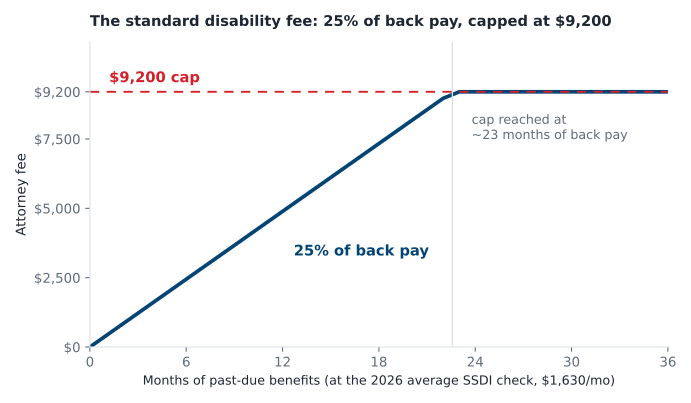
At the 2026 average SSDI benefit of $1,630 a month, 25 percent hits the cap at about 23 months of back pay. Claims that go to a hearing in Arizona routinely take longer than that from application to decision, which means a typical hearing-stage SSDI win pays the representative the cap — and every additional month of back pay beyond that point belongs entirely to the claimant. A fast win at the application stage produces a much smaller fee, often a few thousand dollars. The incentive built into the system is worth noticing: your representative is paid from winning, not from the clock running.
SSI cases follow the same formula with smaller numbers. SSI back pay accrues only from the application month — there are no retroactive benefits before filing — and the 2026 federal payment standard is $994 a month, so an SSI-only fee ordinarily lands well under the cap.
What If You Lose?
Then the fee is zero. Not reduced — zero. Under a standard fee agreement, no back pay means no fee, and the months of work the firm put in are the firm’s loss, not yours. This is why a reputable disability firm screens cases honestly before taking them: it only gets paid for claims it wins.
What a Fee Agreement Does Not Cover
Honesty requires three footnotes, and you should ask any firm you interview about all three:
- Case costs. Obtaining medical records and reports can carry copying or provider charges. These are expenses, not fees — they exist whether or not you have a lawyer, and they are typically modest. Ask how a firm handles them before you sign.
- Federal court is a separate stage. The 25%/$9,200 structure covers proceedings inside Social Security — through the hearing and the Appeals Council. If a case goes on to federal district court, fees there are handled under different rules with their own Social Security oversight.
- The cap moves. It was $6,000 for many years, rose to $7,200 in 2022, and to $9,200 in November 2024; it is now adjusted for inflation going forward. The percentage — 25 — has not changed.
Why Every Firm Charges the Same Thing
Because it is not the firm’s choice. The Social Security Act requires representatives’ fees to be authorized by the agency, and the fee-agreement process sets the 25-percent-to-the-cap structure nationally. A firm cannot lawfully charge you more, cannot bill hourly for agency-level work, and cannot take a fee without Social Security’s sign-off. So when two firms quote the same terms, that is federal law working — and it means price is the one thing you cannot use to choose a representative. What actually differs between firms is who does the work, how cases are prepared, and what happens to your file between filing and hearing day.
It also means a warning sign is easy to spot: anyone asking a disability claimant for money up front, a monthly charge, or a “processing fee” is not operating inside the system that regulates the rest of us.
What This Looks Like in Real Numbers
| Scenario | Back pay | Fee | Claimant keeps |
|---|---|---|---|
| Approved at application, ~8 months of back pay | $13,040 | $3,260 | $9,780 + every check after |
| Approved at hearing, ~24 months of back pay | $39,120 | $9,200 (cap) | $29,920 + every check after |
| Approved at hearing, ~32 months of back pay | $52,160 | $9,200 (cap) | $42,960 + every check after |
| Claim denied at every stage | $0 | $0 | — |
Illustrations at the 2026 average SSDI benefit; individual amounts depend on your earnings record and dates. The pattern is the point: the fee is bounded, the ongoing benefit is untouched, and the risk of losing sits with the representative.
Common Questions
Do I have to pay a disability lawyer up front?
No. Fees in Social Security cases are contingent by design: they are paid out of past-due benefits only if you win, under an agreement Social Security approves. Anyone demanding a retainer for a Social Security claim should be treated with suspicion.
Does the lawyer take part of my monthly check?
No. The fee comes out of the one-time back pay award. Your ongoing monthly benefit is yours in full, from the first regular check onward.
Is a disability lawyer worth 25 percent of my back pay?
That is the right question to ask, and the honest answer is statistical: in Arizona, roughly one initial claim in three is approved, while 61 percent of the cases that reach a judge are approved — and represented claimants are the ones whose files arrive at that hearing complete. The fee only exists in the cases where it bought something: an award. In the alternative — no win — it costs nothing to have tried.
What does a free case review cost?
Nothing, here or at any reputable firm, and it does not obligate you to anything. It is how both sides find out whether the case is one we can win.
Where This Comes From
The fee-agreement structure and agency approval requirement come from the Social Security Act’s representative-fee provisions; the $9,200 cap took effect November 30, 2024 and is adjusted for inflation thereafter, per Social Security’s published notice. The 2026 average SSDI benefit ($1,630) and SSI federal payment standard ($994) are from Social Security’s 2026 cost-of-living figures. Arizona approval rates are computed from Social Security’s published workload files in our approval-rates article. Examples are illustrations, not predictions about any claim.