
Social Security Disability
What to Do After an SSDI Denial in Arizona

A Social Security disability denial notice runs several pages, but the finding itself is usually one sentence: you do not meet Social Security’s definition of disability.
That is the first of four stages in the process, not a final decision. Arizona denies more claims at this stage than almost any other state in the country.
You Have 60 Days, and the Clock Has Already Started
You have 60 days to appeal, running from the date printed on the notice — not the day it arrived, and not the day you opened it. Social Security assumes you received it five days after that date, which gives you an effective 65 in practice. Do not spend them.
Miss the deadline and, in most cases, the denial becomes final. You can start a new application, but you lose the filing date attached to the old one, and with it any back pay that had accumulated. There is a good-cause exception for missing a deadline. It is narrow, it requires a real explanation, and it is not something to plan around.
Nationally, about 17 percent of cases at the hearing level end in dismissal rather than a decision — overwhelmingly missed deadlines, late filings and no-shows. At the Phoenix Downtown hearing office, counting dismissals drops the approval rate from 58.6 percent to 46.0 percent, a difference of nearly thirteen points that has almost nothing to do with anybody’s medical condition.
Put the deadline in your phone today, with a reminder two weeks out.
Read the Notice Before You Do Anything Else
Denials are not all the same, and the reason yours was denied determines what you do next.
Find the date at the top, then find the section that explains why. It is usually a paragraph of general language followed by something more specific. The goal is to work out which kind of denial you received.
A medical denial says Social Security accepts that you have conditions but concluded you can still work: either the job you used to do or some other job. This is the common one, and it is the one an appeal is built for.
A technical denial is different. It says you did not qualify before the medical question was ever reached: not enough recent work credits for SSDI, income or assets above the limits for SSI, or earnings above what Social Security calls substantial gainful activity. Appealing a technical denial without fixing the underlying problem tends to produce the same result.
The most fixable category is a denial for insufficient evidence or failure to cooperate. Records that never arrived, a consultative examination you missed, forms that came back blank, a phone number that stopped working. These read as unfavorable decisions but are really administrative ones.
Appeal. Do Not Start a New Application
The most common mistake after a denial is filing a new application instead of appealing. A new application can feel like a fresh start, and appealing can feel like arguing with a decision already made, but refiling is almost always the worse choice, for a concrete reason.
The original application carries a filing date, and back pay is calculated from it. Starting over surrenders that date. Refile repeatedly and you can spend years accumulating no back pay at all. You will be denied on the same evidence each time because nothing about the file changed.
File the appeal instead. You can do it online through Social Security’s appeal system, by phone, or in person at a field office. Online is generally fastest and gives you a confirmation you can keep.
There is a narrow exception. If your condition has meaningfully worsened since you filed, or a new condition has developed, or you have crossed an age threshold that changes how Social Security evaluates your ability to adjust to other work, a new application may make sense alongside the appeal rather than instead of it. This is a decision to discuss with a representative rather than make alone.
The Four Levels, and Which One You Are On
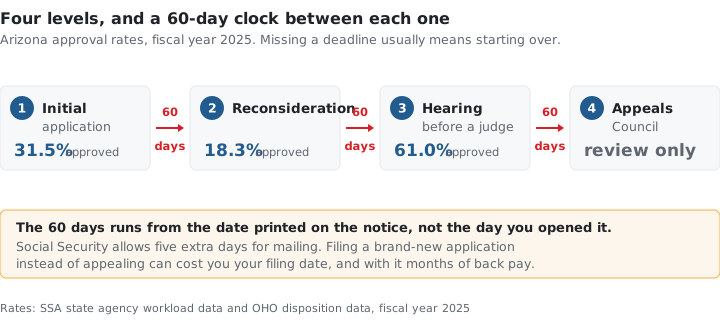
Reconsideration is next. A different examiner at Arizona Disability Determination Services reviews your file. You cannot skip it. Be realistic: Arizona allowed 18.3 percent of reconsiderations in fiscal 2025, which is actually a little better than the national 16.2 percent, but it is still a stage most people do not win. Its real function is to build the record the judge will eventually read.
The hearing before an administrative law judge is where the odds change. Arizona’s three hearing offices together allowed 61.0 percent of the cases judges decided in fiscal 2025, against 58.3 percent nationally — roughly double the initial approval rate.
The Appeals Council reviews whether the judge applied the rules correctly, not whether you are disabled. Most requests are denied, and the common outcome when it does act is a remand for a new hearing.
Federal court is the last step — the U.S. District Court for the District of Arizona, which sits in Phoenix and Tucson.
Where Your Arizona Case Actually Goes
Three offices cover the whole state: Phoenix Downtown, Phoenix North and Tucson. Mesa, Chandler, Glendale, Scottsdale, Tempe, Gilbert, Peoria, Surprise and Casa Grande are Phoenix-area cases. Yuma, Flagstaff, Prescott, Kingman, Lake Havasu City, Sierra Vista, Show Low and Page are assigned depending on geography and workload.
A Social Security field office is different from a hearing office. Field offices in many Arizona cities handle applications and paperwork. Hearings are held in three places, or increasingly by phone or video instead of any of them. Which of Arizona’s three offices you are assigned to, and what that means if you live outside the Phoenix or Tucson metros, is covered in a separate article on Arizona hearing offices.
Most hearings are now held by telephone or online video rather than in person. If you live in Bullhead City or Safford, that removes a genuine hardship: a round trip that used to consume an entire day, sometimes with a companion driving. But the office your case is assigned to still determines two things that matter: which judges can be assigned to you, and how long you wait. Average waits in fiscal 2026 to date have run 273 days at Phoenix Downtown, 296 at Tucson and 350 at Phoenix North, against a national median of 258.
Social Security’s own data describes cases by the state agency that decided them, not by where the claimant lives, which surprises some snowbirds and recent arrivals. States with heavy caseloads transfer claims to other states for workload balancing. If you applied in another state and moved here, or the reverse, your file may not be where you assume.
Why Claims Get Denied Here, and What Actually Fixes It
Thin medical evidence
This is the most common reason and the most fixable. Social Security is not deciding whether you feel unwell. It is deciding what you can still do — how long you can stand, how much you can lift, whether you can maintain attention, whether you would be reliably present at a job. A chart full of diagnoses that never describes function does not answer the question being asked.
Gaps in treatment
An unexplained gap in treatment can read to an examiner as improvement, though the reason is usually money: lost insurance, copays that became unaffordable, a specialist three hours away. Those are acceptable explanations, but only if they appear in the record. No one will ask about the reason for a gap, so it needs to be put in writing.
This affects mental health claims more than most. Depression, anxiety disorders and PTSD are among the most common conditions in Arizona disability claims, and they are also conditions whose symptoms directly cause missed appointments and abandoned treatment. The system then reads the missed appointments as evidence you were not that sick. If that has happened to you, explain the gap in your provider’s notes wherever possible, in the terms that actually caused it.
Heat, which almost nobody documents
This is specific to living in Arizona, and claimants consistently leave it out of their records.
A great many conditions get materially worse in Arizona summers. Multiple sclerosis symptoms worsen with elevated core temperature. Cardiac and respiratory conditions decompensate in extreme heat. A long list of ordinary medications — some antidepressants, antipsychotics, beta blockers, diuretics, anticholinergics — impair the body’s ability to regulate temperature or cause photosensitivity.
The practical effect is that from May through September, you may genuinely be unable to function outdoors, unable to tolerate a workplace that is not consistently cooled, and likely to lose days after any significant heat exposure. Few people describe that as a functional limitation, because it feels like complaining about the weather rather than reporting a symptom. Tell your doctor about it specifically, so it is recorded as a limitation and not as small talk.
Work, earnings and the date last insured
Part-time work does not automatically disqualify you, but earnings above the substantial gainful activity threshold generally will, and any unresolved question about your earnings record routes the file into a separate queue before the medical question is even reached.
For SSDI specifically, there is a trap here. Eligibility depends on having worked recently enough, which produces a date last insured — a deadline in the past. If yours has passed, you must prove you were disabled before it, no matter how sick you are today. That changes which medical records matter, sometimes dramatically, and it is a reason to move quickly instead of waiting to see whether things improve.
Missed exams and unreturned forms
If Social Security schedules a consultative examination, go. Missing one can generate a denial for failure to cooperate and restarts scheduling that takes months. Return function reports completely; “N/A” and blank fields generate follow-up requests, and each request is another cycle of mail and delay. Keep your address and phone current, because notices with deadlines attached still arrive on paper.
What to Do While You Wait
After the appeal is filed, there is typically a long wait before the next step. What happens during that time affects the outcome.
Keep seeing your doctors, consistently. A record that stops the day you applied works against the case; continuing treatment is itself evidence.
Describe function, not just pain. “My back hurts” goes in the chart as a symptom. “I can stand about ten minutes before I have to sit, and I lie down twice a day for an hour” goes in as a limitation, and limitations are what decisions turn on.
Tell Social Security about every new provider, hospitalization and medication change. They will not find records they do not know exist.
Keep a short log. Not a diary — a few lines on bad days: what you could not do, how long it lasted, what you had to stop doing. At a hearing two years from now, specific details will hold up better than general recollection.
Plan for the horizon. Stack the stages, and if you are denied twice you are realistically two to three years from a final answer. If your situation becomes genuinely dire — an eviction or foreclosure notice, a utility shutoff, an inability to afford medication — Social Security has expedited paths for that, but they run on paperwork. Send the eviction notice or the shutoff notice itself, not an account of it.
Why the Number Jumps at a Hearing
People see the initial rate and the hearing rate and assume judges are simply more sympathetic. That may be part of it, but most of the difference is structural, and understanding why is useful.
At the initial and reconsideration levels, an examiner reviews the file on paper. No one hears a description of a bad day, and no one can ask a follow-up question.
At a hearing, four things change. You testify, and a judge can ask what your days actually look like. The record is a year or two more developed than it was. A treating physician’s opinion about your specific limitations can be obtained and put in front of the decision-maker. And a vocational expert testifies about what jobs someone with your limitations could do — testimony that can be questioned, which is often where a case turns. None of that happens automatically; it happens because someone prepared it.
Social Security’s own numbers show why thorough preparation matters. Within a single Arizona hearing office in fiscal 2025, individual judges’ approval rates ranged from 27.8 percent to 88.6 percent. You cannot choose your judge, so your record needs to be strong enough to succeed with the least favorable one you might draw.
What Representation Costs
Fees in Social Security cases are set by federal law, not negotiated. A representative is paid the lesser of 25 percent of your past-due benefits or $9,200, and the fee has to be approved by Social Security. There is no fee if you do not win, and the fee comes out of back pay rather than out of pocket.
That figure has been $9,200 since November 30, 2024 and is not automatically adjusted each year — it changes only when Social Security publishes a notice raising it.
Anyone quoting a different fee structure — an hourly rate, a retainer, a percentage of ongoing monthly benefits — is describing something outside how these cases normally work, and it should raise questions before signing anything.
Before signing with any representative, ask: whether they handle Social Security exclusively or as one practice area among many, who will actually appear at your hearing, whether they will obtain a treating-source opinion, and whether they have appeared before the hearing office your case is assigned to.
What to Do This Week
- Find the date on your denial notice and calendar 60 days from it, with a reminder two weeks before. This is the one deadline that cannot be recovered from casually.
- Work out which kind of denial you received — medical, technical, or a cooperation and evidence problem — because the three call for different responses.
- File the appeal, online or by phone. Do not start a new application in its place.
- Get back in front of your doctors and make sure your limitations, including the ones you have been treating as ordinary life, are written down by someone other than you.
Arizona denies roughly seven of every ten initial claims, and most people who are eventually approved were told no at least once first. The appeal stage is where that most often changes.
For the underlying numbers, see Arizona disability approval rates by stage and hearing office. For why each stage takes as long as it does, see why your Arizona disability case is taking so long.